
We meet at Growing Hollingdean shed on the corner of Brentwood Road and Lynchet Close at 10am. We wait 10 minutes before going on to our location within the estate. One of our Growing Hollingdean volunteers will talk through the mornings plan, give out equipment, including some Health & Safety tips. It’s free fitness, a chance to make new friends, and we always have a good laugh along the way. We look forward to seeing you, rain or shine.
Tree guardians seen in Merevale on Sunday 3rd January 2026
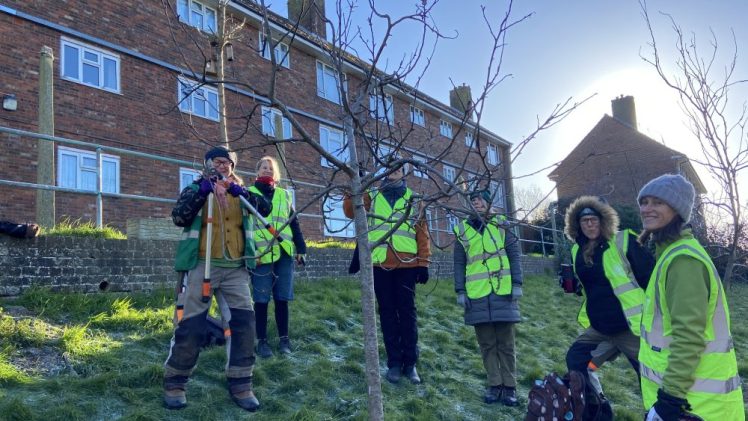
Eight volunteer tree guardians met on first Sunday of the year, a beautiful sunny and very cold morning. With lots of laughter and chatter about the festive holidays, we collected tools from the shed and set off down Stephens Road. The apple first tree we pruned together to remind ourselves the basic rules of pruning. Starting with the three D’s, to cut out Dead, Diseased, or Damaged branches first. Also removing any branches rubbing together to avoid future disease entering the tree.
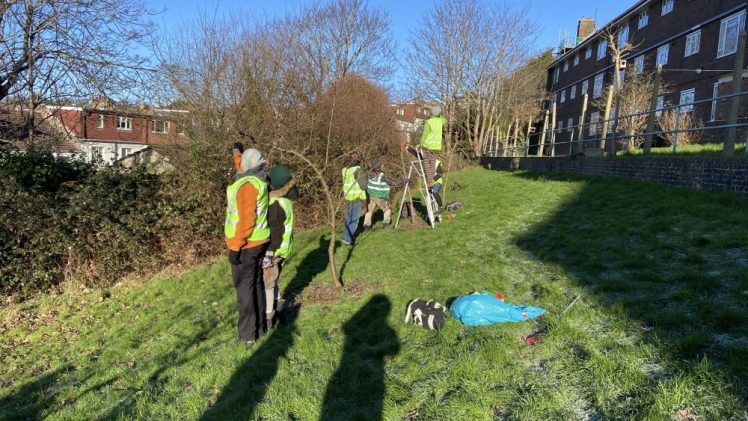
Volunteers pruning together to make decisions
Pruning together, watching and listening to one another, is a deeply relaxing experience. There is no rush when caring for our trees. In the two hours we spent together, seven trees were pruned for the first time in a long while. Three apple trees (numbers 192, 193, and 194) and two pear trees (195 and 196) near Merivale Community Garden were carefully tended. Apple trees 189 and 190 at the bottom of Merivale Green also received a prune.
All of these trees are looking very healthy. Visit our Tree Map to find the fruit and nut trees nearest to you. If you notice a damaged tree on the map, please let us know and we’ll do our best to help.
192 Apple Tree: Patte de loup
Patte de Loup literally, Wolf’s Paw with a brownish yellow skin that often cracks and scars as if a wolf had clawed. An heirloom variety of apple that is grown in the Northwest of France from the Middle Age. Known for their flavour and cooking and chutneys. The fresh apples will keep 1-4 months when properly stored in a cool, dry, and dark place. More information here.
193 Apple Tree: Pomme de Juillet
Pomme de Juillet ia native to the Hautes Cévennes d’Ardèche, the Pomme de Fer apple tree is a hardy French variety, renowned for its resilience in the face of extreme weather conditions. A sweet and slightly tangy flavour, ideal for lovers of crisp apples with a white, slightly tinged with red under the skin. Native to the Hautes Cévennes d’Ardèche, the Pomme de Fer apple tree is a hardy French variety, renowned for its resilience in the face of extreme weather conditions. sweet and slightly tangy flavor, ideal for lovers of crisp apples. More information here.
194 Apple Tree: Bon Père Cooker
Bon père is an old variety recognised and appreciated as a sweet and tangy cooking apple. It produces an ovate, medium to large apple that is irregular and slightly elongated with a waxy, yellow-green skin tinged with salmon pink when exposed to sunlight. More information here.
195 Pear Tree: Epine d Hiver
Epine d Hiver is an ancient French cultivar, possibly from the Limousin region. Smooth green to yellow-green, often with a pink flush as it ripens or cooks. Primarily a cooking pear for desserts, pastries, and drying, rather than fresh eating.
194 Apple Tree: Bon Pere
Bon Père (good father) is a cooking apple tree, produces large, bell-shaped pears with a smooth, white or creamy flesh. The skin is typically green, turning a rich golden-yellow as it ripens, sometimes with a red flush on the sun-exposed side. Fruit ready for picking from late August to mid-September. The fruit has a characteristic musky aroma and is very sweet and juicy. It is excellent for eating fresh, poaching, preserving, or canning.
196 Pear Tree: General Leclerc
General Leclerc pear tree produces very large, juicy, sweet-tart pears with fine, melting flesh and honey-brown skin, named after the French general, popular for fresh eating and cooking, requiring cross-pollination for best yield but known for robust growth and good disease resistance, ripening in autumn.
190 Apple Tree: Claygate Pearmain
Claygate Pearmain Apple tree is a classic English heritage apple, discovered in a hedge at Claygate, Surrey, in the 1820s, known for its sweet, nutty, aromatic flavour, juicy texture, and russeted skin, making it a popular Victorian dessert apple that stores well and is resistant to scab, thriving in small gardens.
189 Apple Tree: Ashmeads Kernel
Ashmead’s Kernel apple tree is a highly-prized, old English heritage russet apple, famous for its complex, rich flavour reminiscent of pear drops and citrus, making it excellent for eating, juicing, and cider, despite its less-than-perfect looks. This late-season variety has firm, crisp flesh, good disease resistance, and stores well, though trees can be inconsistent croppers, requiring a pollinator.
188 Apple Tree: Amoriaque
Amoriaque is a traditional French dessert apple cultivar. It is often sought for its historic value.
 Growing Hollingdean